
Synthetic Oil vs. Conventional Oil: What’s the Difference?
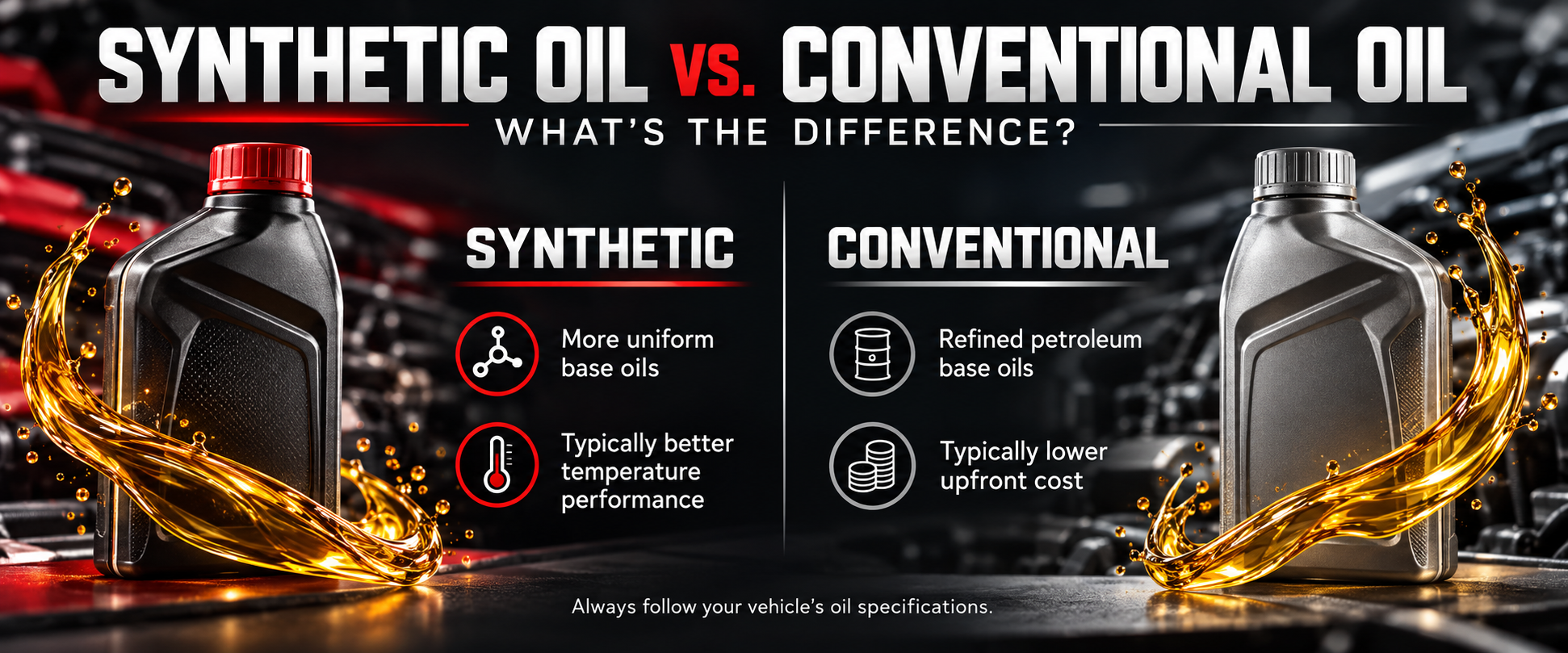
Synthetic oil generally offers stronger resistance to heat, oxidation, and cold weather thickening than conventional oil. However, the right oil for your vehicle is the one that meets its manufacturer’s viscosity and performance requirements—not simply the option with the highest price.
Choosing an oil change used to sound straightforward. Today, drivers may be offered conventional oil, synthetic blend, full synthetic, and high-mileage formulations, sometimes in several viscosity grades.
Those choices are not interchangeable.
A vehicle that requires an approved full synthetic oil should receive that product. An older engine designed for conventional oil may have more flexibility, provided the selected oil meets the applicable requirements.
For Massachusetts drivers, cold starts, stop-and-go commuting, and seasonal temperature changes make the differences worth understanding.
The goal is to choose an oil that protects your engine while keeping maintenance decisions practical.
What Is Conventional Motor Oil?
Conventional motor oil uses mineral base oils refined from crude oil and an additive package.
The base oil provides the foundation for lubrication. Additives help the finished oil perform tasks such as controlling deposits, limiting oxidation, protecting against wear, and reducing foaming.
Conventional oil is therefore more than untreated petroleum. It is an engineered lubricant, even though its base-stock processing differs from that of many synthetic products.
For engines designed to use it, a conventional oil that meets the correct requirements can provide adequate protection when changed on schedule.
The limitation is that conventional formulations generally have less performance margin under demanding temperature and operating conditions than comparable modern synthetics.
That distinction becomes more important in engines with specific lubrication requirements.
What Is Full-Synthetic Motor Oil?
Full synthetic oils use highly processed or chemically produced base stocks with additive systems developed for particular performance targets.
The category includes different formulations. It does not mean every synthetic oil uses the same chemistry or provides identical performance.
In general, synthetic oils offer advantages in temperature stability, oxidation resistance, and low temperature performance. Oil manufacturer Mobil also identifies deposit control and protection under demanding operating conditions among the benefits of suitable synthetic formulations. Source: Mobil
These characteristics help explain why many newer vehicles require synthetic oil.
However, a bottle labeled “full synthetic” may still be unsuitable if it lacks the engine’s required approval.
The oil’s specifications matter at least as much as the category on the front label.
Synthetic vs. Conventional Oil at a Glance
| Consideration | Conventional oil | Full synthetic oil |
| Base formulation | Refined mineral base oils | Highly processed or chemically produced base stocks |
| Cold-weather performance | Depends on grade and formulation | Generally stronger low-temperature performance |
| Resistance to heat and oxidation | Suitable within its intended application | Generally greater resistance |
| Purchase price | Usually lower | Usually higher |
| Service interval | Follow the vehicle’s requirements | Follow the vehicle’s requirements |
| Suitability | Only where specifications are met | Only where specifications are met |
The table shows broad differences, not a substitute for checking your owner’s manual.
Two oils can share a viscosity grade while meeting different performance standards. Conversely, two oils with different marketing labels may both be permitted for a particular engine.
What Is Synthetic Blend Oil?
Synthetic blend oil combines synthetic and conventional base stocks.
It is often positioned between conventional and full-synthetic oil in price and performance. However, the label does not tell you an exact, universally standardized percentage of synthetic base oil.
One blend can differ substantially from another.
A synthetic blend may be appropriate when it meets your vehicle’s requirements, but it should not be assumed to satisfy a requirement for a particular full synthetic product or manufacturer approval.
If you are comparing service options, ask what oil specification each option meets.
That produces a more useful answer than asking whether a blend is “almost synthetic.”
Why Cold Weather Performance Matters in Massachusetts
Motor oil becomes more resistant to flow as temperature falls.
During a cold start, the lubrication system must circulate oil through the engine while components are still cold. The oil’s winter viscosity rating helps describe its low temperature performance.
A suitable synthetic formulation can provide useful cold weather advantages, but viscosity grade remains essential.
For example, switching to an unapproved grade because it seems better for winter is not a sound maintenance strategy.
Massachusetts drivers should use the grade specified for their vehicle and any alternatives explicitly permitted by the manufacturer.
The same principle applies to vehicles parked outdoors, driven early in the morning, or used mainly for short trips.
Hogan Tire’s oil change services can help match the oil to the vehicle rather than relying on a seasonal guess.
Does Synthetic Oil Last Longer?
Synthetic oil can support longer service intervals in vehicles designed for it, but switching oil types does not automatically change your maintenance schedule.
The interval depends on the engine, required oil, driving conditions, and manufacturer guidance.
A vehicle with an oil life monitor may adjust its service estimate based on operating conditions. Another vehicle may use fixed mileage and time limits.
Repeated short trips, heavy towing, extended idling, and other demanding conditions can affect the schedule.
Do not select an interval solely from the number printed on an oil bottle. A product’s advertised protection claim may include conditions that differ from your vehicle’s requirements.
Likewise, do not assume that all conventional oil requires the same interval.
The correct question is: How long is this oil approved to remain in this engine under these operating conditions?
Is Synthetic Oil Worth the Higher Price?
If your vehicle requires it, synthetic oil is part of the cost of proper maintenance.
When both conventional and synthetic oil are permitted, the decision can involve operating conditions, maintenance convenience, and cost.
A driver facing frequent cold starts or demanding engine operation may value the additional performance margin of a suitable synthetic oil.
The price difference should also be considered over the approved service interval rather than only at checkout.
For example, a hypothetical $90 service every 7,500 miles results in a lower service cost per mile than a $60 service every 3,000 miles. Those numbers are examples, not Hogan Tire pricing or recommendations for your vehicle.
The comparison only works when both intervals are actually permitted.
Paying more for oil does not justify extending service beyond the manufacturer’s requirements.
Can You Switch From Conventional to Synthetic Oil?
For most passenger vehicles, switching to a suitable synthetic oil during a normal oil change is straightforward.
The replacement oil must meet the correct viscosity and performance specifications.
A special engine flush is not automatically necessary merely because the oil category is changing.
If the engine has an unknown maintenance history, significant deposits, leaks, or unusual oil consumption, those issues deserve evaluation. The decision should account for the engine’s condition rather than relying on a general rule about old cars.
Switching oil does not repair worn components or reverse damage from previous neglect.
After any oil change, continue checking the level according to the owner’s manual and report changes in consumption or leakage.
Will Synthetic Oil Make an Older Engine Leak?
Synthetic oil is not inherently incompatible with older engines.
An engine’s seals and gaskets can deteriorate with age, temperature cycles, and wear. Existing leaks may become noticeable around the same time as an oil change, but timing alone does not establish the cause.
If a leak appears after service, have it inspected.
The issue could involve an existing gasket problem, a filter seal, a drain plug seal, an incorrect fill level, or another condition.
Do not assume the solution is automatically switching back to conventional oil.
For some older engines, an appropriate high-mileage formulation may be useful. It still needs to meet the engine’s specifications, and it cannot replace a necessary repair.
Is High-Mileage Oil the Same as Synthetic Oil?
No. These labels describe different features.
“High-mileage” refers to a formulation intended for engines with accumulated age or mileage. “Synthetic” refers to the oil’s base stock category and formulation approach.
A high-mileage oil can also be full synthetic or a synthetic blend.
Some high-mileage products include seal conditioning additives and other formulation choices intended for older engines.
The label does not mean the oil is automatically thicker, nor does it mean every vehicle needs it after crossing a particular mileage threshold.
An engine operating normally on its specified oil may not need a change in formulation simply because the odometer reaches 75,000 miles.
Can You Mix Synthetic and Conventional Oil?
Many passenger car engine oils are compatible in that mixing them does not automatically cause a damaging chemical reaction.
However, compatibility is not the same as retaining every advertised performance benefit or manufacturer approval.
The best routine practice is to use the specified oil consistently.
If the engine needs oil between services, follow the owner’s manual for permitted top-off products. Do not deliberately mix random oils to create a custom blend.
A top-off also does not reset the oil change interval.
The used oil, filter, and accumulated operating history remain part of the system.
Oil Viscosity Is a Separate Decision
Numbers such as 0W-20 and 5W-30 describe viscosity classifications.
They do not tell you whether the oil is conventional or synthetic.
A 5W-30 conventional oil and a 5W-30 synthetic oil share the same broad viscosity classification, but they can differ in oxidation resistance, approvals, and other characteristics.
Similarly, an approved 0W-20 oil is not “too thin” simply because its numbers are lower than those used in an older vehicle.
The engine was designed around particular lubrication requirements.
Changing viscosity without approval can affect lubrication, variable valve timing, and other oil-dependent systems.
Why Oil Color Is Not a Reliable Shopping Guide
Used oil often darkens as it operates.
That change can reflect additives holding contaminants in suspension, heat exposure, and other normal processes.
Dark oil does not automatically mean a synthetic formulation has failed. Clean-looking oil does not prove that the oil is still suitable for extended use.
Mileage, elapsed time, service history, and operating conditions provide a better foundation for routine maintenance decisions.
If contamination is suspected, appearance may be one clue, but it should be evaluated alongside other evidence.
An unusual rise in oil level, coolant loss, or a significant change in consumption deserves attention rather than a simple brand change.
Build Oil Service Into a Complete Maintenance Plan
Even the best engine oil cannot compensate for neglected tires, worn brakes, or a failing cooling system.
An oil-change appointment is a useful time to review other scheduled services and mention symptoms you have noticed.
That might include a slow crank in the morning, steering vibration, an unexplained fluid spot, or a change in braking performance.
Hogan Tire’s preventive maintenance services provide a broader framework for keeping the vehicle’s service schedule organized.
Maintenance should reflect what is due and what inspection reveals. It should not become an automatic list of replacements based solely on the season.
Fall Car Care: Prepare for Cooler Starts
Fall is a good time for Massachusetts drivers to confirm that their vehicle has the correct oil and is up to date on service before winter conditions arrive.
It is also a practical time to inspect tire condition, check windshield wipers, test the defroster, and evaluate starting performance.
If the engine has begun cranking slowly, a battery and charging system inspection can help identify the cause before a colder morning exposes the problem.
For a broader seasonal overview, use the Car Concepts fall car care guide.
The goal is to address actual maintenance needs before weather and travel schedules make them more inconvenient.
Frequently Asked Questions
Is full-synthetic always better than a synthetic blend?
A suitable full-synthetic generally offers better performance capabilities, but the right choice still depends on the engine’s specifications. An unapproved full synthetic is not a better choice than an approved product.
Can an older car use synthetic oil?
Usually, as long as the oil meets the engine’s requirements. Existing leaks, oil consumption, or an uncertain maintenance history should be reviewed separately.
Does synthetic oil improve gas mileage?
Oil choice can affect friction and efficiency, but results depend on the vehicle and the products compared. Do not expect a guaranteed mileage increase simply from changing the label category.
Can I go back to conventional oil?
Only if conventional oil meeting the required specifications is permitted for your engine. Follow the manufacturer’s requirements rather than assuming the switch is always appropriate.
Does synthetic oil eliminate the need to check the oil level?
No. Oil level and oil condition are different issues. A vehicle can lose or consume synthetic oil just as it can other engine oil.
Choose the Right Oil With Hogan Tire
Choosing between synthetic and conventional oil becomes easier when the discussion starts with your vehicle’s requirements.
Hogan Tire & Auto serves Massachusetts drivers with oil change and filter service, as well as broader maintenance support.
When scheduling, provide your vehicle information, describe your driving habits, and mention any oil consumption or leaks. That helps make the service appropriate for the engine you own and the conditions it faces.