
All-Season vs. All-Weather vs. Winter Tires: What’s the Difference and Which Should You Choose?
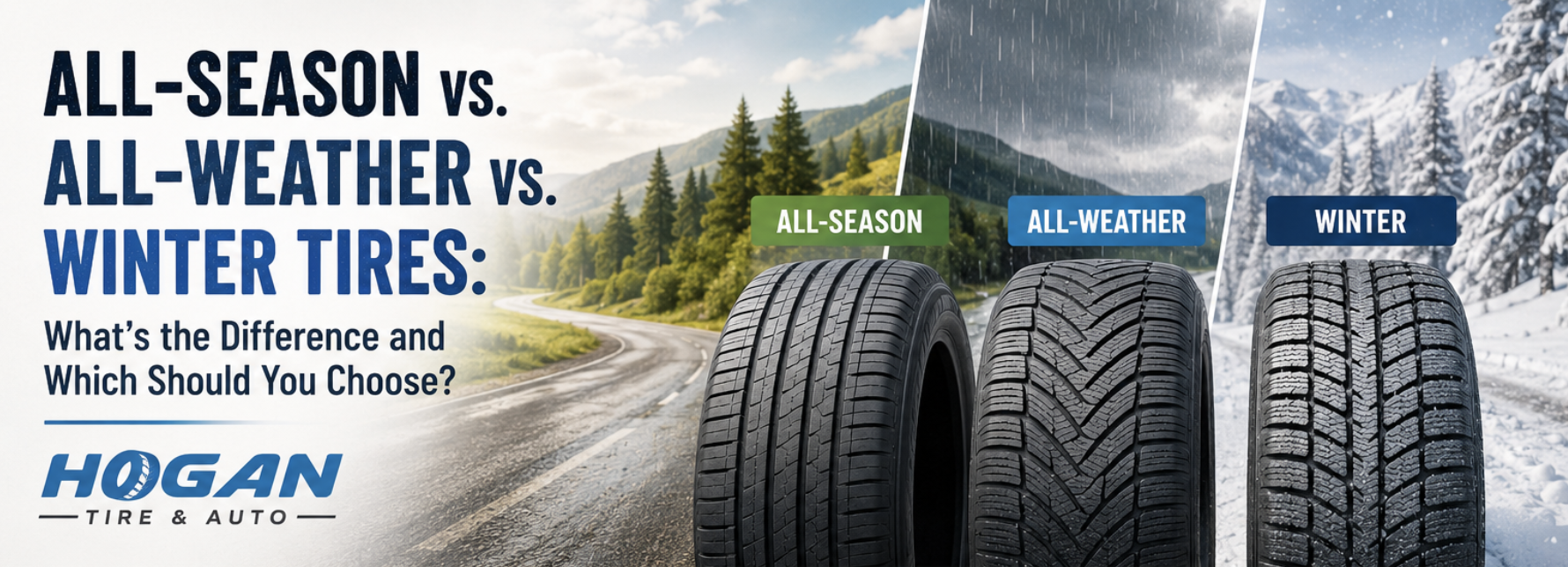
All-Season vs. All-Weather vs. Winter Tires: What’s the Difference and Which Should You Choose?
Shopping for tires sounds simple until you encounter three categories that appear to promise nearly the same thing: all-season, all-weather, and winter tires. All three can be driven in cold conditions. All three may carry some form of snow-related marking. Depending on the model, all three may even be advertised as suitable for year-round driving.
That does not mean they perform the same way.
All-season tires prioritize year-round comfort, mileage, and balanced performance. All-weather tires are designed to provide better snow performance without requiring a seasonal tire change. Dedicated winter tires place the greatest emphasis on cold-weather grip, snow traction, and control on ice.
Hogan Tire & Auto helps Massachusetts drivers compare all-season tires, all-weather tires, and winter tires based on the vehicle, commute, road conditions, driving habits, and budget—not simply the wording printed on the sidewall.
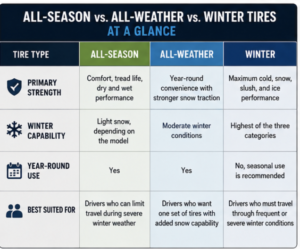
All-Season, All-Weather, and Winter Tires at a Glance
| Tire type | Primary strength | Winter capability | Year-round use | Best suited for |
| All-season | Comfort, tread life, dry and wet performance | Light snow, depending on the model | Yes | Drivers who can limit travel during severe winter weather |
| All-weather | Year-round convenience with stronger snow traction | Moderate winter conditions | Yes | Drivers who want one set of tires with added snow capability |
| Winter | Maximum cold, snow, slush, and ice performance | Highest of the three categories | No, seasonal use is recommended | Drivers who must travel through frequent or severe winter conditions |
Why the Names Cause Confusion
“All-season” suggests year-round performance, while “all-weather” sounds nearly identical. Winter tires are also called snow tires, which can imply they are useful only in deep snow. In reality, these terms describe different performance priorities.
All-season tires balance warm-weather, wet-road, and limited cold-weather performance. Many carry an M+S marking, but this does not indicate the same severe-snow capability as the Three-Peak Mountain Snowflake (3PMSF) symbol.
All-weather tires are designed for year-round use and generally carry the 3PMSF symbol, meaning they meet a recognized severe-snow traction standard. However, performance still varies by model.
Dedicated winter tires also carry the 3PMSF symbol but use specialized rubber compounds, tread patterns, and siping that prioritize traction in cold temperatures, snow, slush, and ice.
The key distinction is simple: All dedicated winter tires are designed for severe winter conditions, but not every 3PMSF-rated tire is a dedicated winter tire.
What Are All-Season Tires?
All-season tires are the default choice on many passenger cars, crossovers, SUVs, and light trucks. They are engineered to operate across a broad temperature range while balancing tread life, ride comfort, noise, steering response, wet traction, dry braking, and some light-snow capability.
That balance is their greatest strength and their main limitation.
A good all-season tire can provide a quiet highway ride, predictable wet-road handling, respectable fuel efficiency, and long tread life. For drivers in moderate climates, it may genuinely serve as a year-round solution. Hogan Tire & Auto offers all-season tires for Massachusetts drivers in a range of sizes, brands, tread designs, and performance categories.
However, an all-season tire is not simply a winter tire that lasts longer. Its compound must remain stable enough to handle summer heat. Its tread blocks must be firm enough to provide reasonable dry-road steering and braking. Its pattern must control water without becoming excessively loud or flexible.
Those requirements limit how aggressively the tire can be optimized for snow and ice.
How All-Season Tread Designs Work
All-season tires usually contain circumferential grooves to evacuate rainwater, lateral channels to move water and slush away from the contact patch, and smaller cuts that create additional edges for light snow.
Compared with winter tires, all-season tread blocks are generally less heavily siped and more stable. That can improve dry handling and reduce tread squirm, particularly at highway speeds or during warm-weather cornering.
The tradeoff appears when the road becomes covered in packed snow or ice. Fewer biting edges and a less winter-focused compound may mean the tire has more difficulty accelerating, turning, and stopping.
What Are All-Weather Tires?
All-weather tires attempt to bridge the gap between conventional all-season tires and dedicated winter tires. They are designed for year-round use but typically feature a more winter-capable compound and tread pattern than standard all-season models.
For many Massachusetts drivers, this is an attractive compromise. There is no need to store a second tire set or schedule spring and fall changeovers, yet the tire offers more winter traction than a traditional all-season product.
The easiest way to identify most all-weather tires is to look for the Three-Peak Mountain Snowflake symbol on the sidewall.
What the Three-Peak Mountain Snowflake Symbol Actually Means
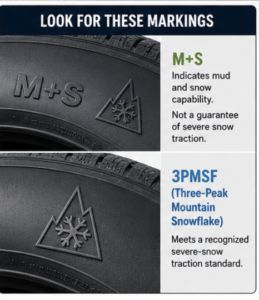
The symbol shows a snowflake inside a mountain with three peaks. Tires carrying it have met a standardized performance threshold for acceleration traction on medium-packed snow compared with a reference tire.
The symbol indicates more than the basic M+S marking. However, the test has limits.
The 3PMSF test does not certify a specific level of:
- Ice braking
- Snow braking
- Cornering grip
- Wet-road performance
- Deep-snow mobility
- Resistance to hydroplaning
It evaluates a defined type of longitudinal snow traction. Tire Rack notes that the qualifying test centers on acceleration traction in medium-packed snow and does not directly test snow braking, lateral grip, or ice performance.
That does not make the symbol meaningless. It remains one of the most useful sidewall indicators when comparing winter capability. It simply should not be interpreted as proof that an all-weather tire equals a dedicated winter tire in every cold-weather situation.
How All-Weather Tires Differ From All-Season Tires
All-weather designs usually have a higher density of sipes, more open channels for slush and snow evacuation, and compounds intended to remain more compliant in cold temperatures. Many use directional or highly segmented tread patterns to increase the number of edges interacting with snow.
Compared with a conventional all-season tire, an all-weather tire will generally provide:
- Better acceleration in snow
- More dependable cold-weather traction
- Better performance in slush
- Greater confidence during moderate winter storms
- Legal severe-snow qualification where that designation is relevant
The compromise is that some all-weather tires may produce more road noise, feel less crisp in warm-weather cornering, wear faster, or deliver slightly lower fuel economy than a touring-focused all-season tire. Modern designs have narrowed those differences considerably, but the fundamental engineering tradeoff still exists.
Who Should Consider All-Weather Tires?
All-weather tires are especially useful for drivers who experience regular winter weather but do not necessarily require the highest possible snow-and-ice performance.
They may make sense when:
- You want to keep one set of tires on the vehicle all year.
- Your area receives recurring snow, but roads are usually plowed promptly.
- You commute on main roads rather than remote or steep secondary roads.
- You need more winter capability than a normal all-season tire provides.
- You do not have convenient storage for a second tire set.
- You can reduce or postpone travel during the worst storms.
All-weather tires have generally performed better than conventional all-season tires in winter testing, but they may still not replace dedicated winter tires for frequent ice, deep snow, mountain travel, or severe storms.
What Are Winter Tires?
Winter tires are designed to maintain traction on cold pavement, when roads may be covered by snow, slush, or ice.
Everything about the tire is influenced by that objective. The rubber compound is formulated to remain flexible in low temperatures. The tread pattern contains numerous edges that can engage snow. Deep channels help move slush. Sipes allow the tread blocks to deform, creating additional gripping surfaces.
Hogan Tire & Auto carries winter tires for cars, SUVs, crossovers, and light trucks and provides professional installation at its Massachusetts locations.
Why Winter Tires Use Softer Compounds
A tire grips the road through a combination of mechanical interaction, adhesion, tread deformation, and the management of water, snow, or ice at the contact patch.
In cold conditions, a winter compound remains more compliant than a typical all-season compound. This allows the tread to more effectively conform to the surface rather than behaving like a harder plastic.
The result is not simply better acceleration. A proper winter tire can also improve braking, steering response, lateral stability, and the driver’s ability to control the vehicle during evasive maneuvers.
What Sipes Do
Sipes are the narrow cuts visible across individual tread blocks. As the tire rolls, those cuts open slightly and create many small biting edges.
Winter tires use significantly more siping than most all-season tires. Some designs use zigzag, interlocking, or three-dimensional sipes that provide snow and ice traction while helping the tread block remain stable.
Siping must be carefully engineered. A large number of simple cuts can make a tread block too flexible, creating vague steering and excessive heat. Modern winter tires often use complex internal shapes to balance flexibility and stability.
How Winter Tires Handle Snow and Ice
Winter tires improve snow traction by capturing snow in the tread, allowing snow-to-snow contact to create grip. Wide grooves also clear loose snow and slush, preventing them from packing the tread.
On ice, flexible rubber compounds, dense siping, and specialized tread patterns help maintain contact and improve traction. However, no tire can make ice behave like dry pavement, so drivers should still reduce speed, increase following distance, and brake or steer gradually.
All-Season vs. All-Weather vs. Winter Tires in Different Conditions
The best way to determine which tires you need is to consider how each design behaves in the conditions you encounter on a regular basis.
Rain and Standing Water
Wet performance depends heavily on the individual tread design, compound, remaining tread depth, road surface, and vehicle speed.
All-season tires often provide excellent rain performance because many are designed around wet-road commuting. All-weather tires can also perform well, but the presence of the snowflake symbol alone does not guarantee superior rain traction.
Winter tires contain deep channels that can move water and slush, but they are not automatically the best rain tires, particularly in warm conditions. Softer tread blocks may move more under braking or cornering.
Regardless of category, worn tread reduces the tire’s ability to manage water. The National Highway Traffic Safety Administration (NHTSA) advises replacing the tires once the tread reaches 2/32 of an inch and recommends regular pressure and tread inspections. That is the legal or basic safety threshold, not necessarily the ideal depth for dependable winter or heavy-rain performance.
Light Snow
A quality all-season tire with good tread may be adequate in light snow, particularly on flat roads that receive prompt treatment.
An all-weather tire should generally provide a stronger margin of snow traction because it is designed to meet the severe-snow acceleration standard.
A winter tire remains the strongest option, but its full advantage may not be obvious during a minor dusting on treated pavement.
Packed Snow
The performance gaps become more apparent on packed snow.
All-season tires may struggle to generate enough bite for confident braking and steering. All-weather tires generally perform better because of additional siping, more winter-oriented compounds, and snow-capable tread patterns.
Dedicated winter tires are designed specifically for this environment and usually provide the most predictable control.
Deep Snow
Deep snow places different demands on the tire. It must generate forward traction while clearing snow from the tread and resisting the tendency to become packed.
Dedicated winter tires generally provide the best capability. All-weather performance varies by model, vehicle clearance, drivetrain, and snow depth. Conventional all-season tires are the least dependable of the three when snow becomes deep or the roads remain unplowed.
Slush
Slush combines several hazards. It can reduce contact with the pavement, pull the vehicle toward deeper sections, and refreeze into uneven or icy surfaces.
Tread evacuation becomes critical. Winter and all-weather tires often use open channels and directional elements designed to move slush away. A worn tire of any category may struggle because its reduced groove volume cannot manage as much material.
Ice and Freezing Rain
Dedicated winter tires offer the clearest advantage on ice, although performance varies substantially among models.
All-weather tires may outperform conventional all-seasons, but the 3PMSF marking does not certify ice grip. Drivers who routinely travel during freezing rain, before road treatment, or on roads prone to black ice should not assume that an all-weather tire provides the same protection as a dedicated winter model.
All-Season Tires May Be Enough When You Can Avoid the Worst Weather
All-season tires can be a reasonable choice for drivers who primarily stay on treated roads and can delay travel during significant snow or ice.
They are also attractive for drivers who prioritize quiet operation, long tread life, fuel efficiency, and warm-weather performance.
The key is being honest about your winter exposure. A vehicle that sits in the driveway during storms has different tire needs from one that must get you to work regardless of road conditions.
All-Weather Tires Fit Many Four-Season Commuters
All-weather tires may be the best compromise for many Massachusetts drivers. They provide a meaningful step up from conventional all-season tires in snow while avoiding seasonal changeovers.
They are particularly appealing for drivers who experience several winter storms each year but generally travel on plowed, treated roads.
However, convenience should not be mistaken for maximum capability. A driver who regularly encounters untreated hills, early-morning ice, heavy snowfall, or long rural routes may benefit more from dedicated winter tires.
Winter Tires Are Best When Travel Is Not Optional
Winter tires are the strongest choice for essential workers, long-distance commuters, early-shift drivers, families traveling through recurring storms, and anyone who cannot simply wait for conditions to improve.
They are also worth considering for rear-wheel-drive vehicles, performance cars fitted with summer or aggressive performance tires, and vehicles that must negotiate steep roads.
The value of a winter tire is not limited to whether the vehicle can get moving. It also affects the ability to stop and steer, functions that all-wheel drive cannot provide on its own.
Find the Right Tires at Hogan Tire & Auto
The choice between all-season, all-weather, and winter tires is ultimately a matter of performance priorities.
Choose all-season tires when most of your driving occurs on clear pavement, severe winter travel can be avoided, and comfort and tread life are major priorities.
Choose all-weather tires when you want one year-round tire with more dependable snow capability than a conventional all-season model.
Choose winter tires when you need the greatest possible margin of control during cold temperatures, recurring snow, slush, freezing rain, or icy Massachusetts commutes.
Hogan Tire & Auto can help you compare tire models based on your vehicle and actual driving conditions. You can shop for tires online, review Hogan’s tire installation and warranty package, or find a Hogan Tire & Auto location in Hudson, Lowell, Medway, Natick, North Beverly, Waltham, Westwood, or Woburn. For installation, seasonal changeover, balancing, alignment, or tire inspection, schedule tire service online.