
Tire Replacement vs. Repair: Pros and Cons
Tire Replacement vs. Repair: What Most Drivers Don’t Realize Until It’s Too Late
A nail in the tread. A tire that’s slowly losing air. Uneven wear that seems to be getting worse every month. Most drivers eventually find themselves asking the same question:
Should this tire be repaired, or is it time to replace it?
The answer isn’t always obvious.
In some situations, a professional repair can safely restore the tire and provide thousands of additional miles of service. In others, a repair may technically stop the air leak but fail to address deeper issues that affect safety, performance, and long-term value.
The challenge is that the visible damage isn’t always the real problem. A small puncture can hide significant internal damage, while a tire that appears repairable may already be approaching the end of its useful life.
Understanding the difference can save money, improve safety, and help you avoid replacing tires before it’s necessary.
Not Every Flat Tire Needs to Be Replaced
One of the biggest misconceptions drivers have is that every punctured tire automatically requires replacement.
In reality, many punctures can be repaired safely when they meet industry repair guidelines.
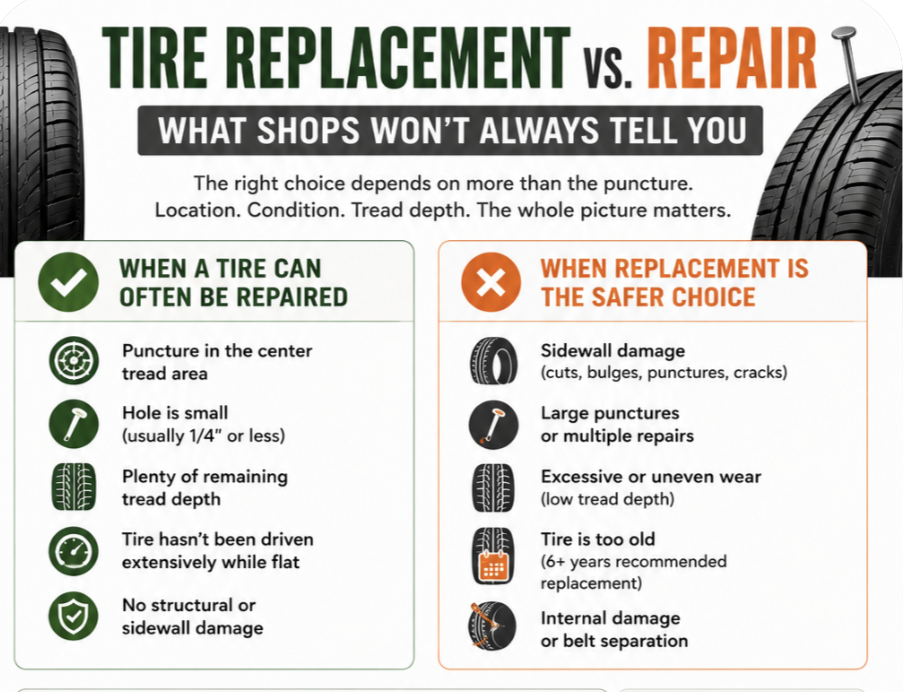
Generally, a repair may be possible when:
- The puncture is located in the center tread area
- The hole is relatively small
- The tire has adequate remaining tread depth
- The tire has not been driven extensively while flat
- No internal structural damage is present
Modern tire repairs are far different from the temporary plug kits sold at convenience stores. A proper repair involves inspecting the inside of the tire and sealing both the puncture channel and the inner liner.
When performed correctly, a professional repair can restore the tire’s ability to hold air and continue delivering reliable performance for years.
When Tire Replacement Is the Better Choice
There are situations where replacement is the only responsible recommendation.
Even when a tire appears repairable from the outside, hidden structural damage can make continued use unsafe.
Experienced technicians often recommend replacement when they find:
- Sidewall damage
- Large punctures
- Multiple previous repairs
- Belt separation
- Significant internal damage
- Excessive tread wear
- Age-related cracking or dry rot
In these situations, replacement isn’t about selling a tire. It’s about preventing a future failure.
Why Sidewall Damage Almost Always Means Replacement
Few tire issues generate more confusion than sidewall damage.
Drivers often assume that if a puncture is small enough, it can be repaired regardless of location.
Unfortunately, that isn’t how tires work.
The sidewall constantly flexes while the vehicle is moving. Every acceleration, stop, turn, pothole impact, and road imperfection causes the sidewall to bend and deform.
Because of this constant movement, repairs in the sidewall cannot reliably maintain structural integrity.
Common sidewall problems include:
- Punctures
- Cuts
- Bulges
- Impact breaks
- Cracking
- Dry rot
Massachusetts drivers encounter sidewall damage frequently due to potholes that develop throughout the winter and spring months. In many cases, the tire may not immediately lose air, yet the internal cords have already been damaged.
Once the sidewall structure is compromised, replacement is generally the safest option.
What Happens When You Drive on a Flat Tire?
One of the most overlooked factors in tire repair decisions is how long the tire was driven after losing air.
Many drivers discover a nail and assume the puncture itself determines whether a tire can be repaired.
In reality, technicians are often more concerned about what happened after the puncture occurred.
A properly inflated tire supports the vehicle’s weight through air pressure. When air pressure drops significantly, the tire’s sidewalls begin carrying loads they were never designed to handle.
This creates excessive heat and internal stress.
Even if the puncture is small and located in a repairable area, driving on the tire while underinflated can damage:
- Internal sidewall cords
- Steel belts
- Structural plies
- Inner liner components
This damage is often invisible from the outside.
That’s why professional tire repairs require internal inspection before any recommendation is made.
Why the Location of the Puncture Matters
Many drivers focus on the size of the puncture.
Experienced technicians often focus first on the location.
The center tread area experiences relatively little flex while driving. This makes it the safest location for repair.
The shoulder area and sidewall are different.
These areas flex constantly and experience significantly higher stress loads.
As a result, a tiny puncture in the sidewall may require replacement while a larger puncture in the center tread may still qualify for repair.
Location often matters more than size.
Pros and Cons of Tire Repair
Repairing a tire can be an excellent solution when the tire is otherwise in good condition.
Advantages of Tire Repair
- Lower immediate cost
- Faster service
- Extends usable tire life
- Allows you to keep matching tires
- Reduces unnecessary waste
Disadvantages of Tire Repair
- Not all damage is repairable
- Existing wear remains unchanged
- Previous repairs may limit future repairs
- Does not correct alignment or suspension problems
- May not make sense on a worn tire
For many drivers, a proper repair offers tremendous value when significant tread life remains.
Pros and Cons of Tire Replacement
Replacement carries a higher upfront cost but often provides greater long-term value when the tire is nearing the end of its life.
Advantages of Tire Replacement
- Restores full tread depth
- Improves wet-weather traction
- Improves snow performance
- Eliminates concerns about hidden damage
- Provides maximum remaining tire life
- Improves overall handling and braking performance
Disadvantages of Tire Replacement
- Higher upfront investment
- May require replacing multiple tires
- Can create tread depth differences between tires
- Doesn’t solve underlying suspension or alignment issues
The goal isn’t simply finding the cheapest solution. The goal is finding the safest and most cost-effective solution over time.
Tread Depth Matters More Than Most Drivers Realize
Tread depth often determines whether a repair makes financial sense.
A tire nearing replacement depth may technically be repairable. That doesn’t necessarily mean repairing it is the best investment.
As tread depth decreases, tires gradually lose their ability to:
- Channel water away from the contact patch
- Resist hydroplaning
- Maintain traction in wet conditions
- Deliver predictable braking performance
- Provide winter traction
This is particularly important throughout Eastern Massachusetts, where rain, slush, snow, and rapidly changing weather conditions are common.
Sometimes the smartest financial decision is replacement, even when repair remains possible.
The Hidden Cost of Waiting Too Long to Replace Tires
Many drivers focus on the immediate cost difference between a repair and a replacement.
What often gets overlooked is the long-term cost of driving on worn tires.
As tread depth decreases:
- Wet-weather stopping distances increase
- Hydroplaning resistance decreases
- Cornering stability declines
- Emergency handling performance worsens
The result isn’t just reduced performance. It’s reduced safety.
A tire that still “looks okay” may no longer provide the traction needed during an emergency maneuver or sudden stop.
Uneven Tire Wear Usually Signals a Bigger Problem
A tire rarely wears out for no reason.
When technicians see unusual wear patterns, they often begin looking beyond the tire itself.
Common causes include:
- Improper wheel alignment
- Worn suspension components
- Steering system wear
- Underinflation
- Overinflation
- Missed tire rotations
Replacing the tire without addressing the root cause frequently leads to the same problem occurring again.
That’s why a quality tire inspection involves evaluating the entire vehicle rather and fixing bad alignment than simply replacing the damaged tire.
Why Wheel Alignment Can Save You Thousands of Miles
One of the most common reasons drivers replace tires prematurely is poor alignment.
When alignment angles fall outside manufacturer alignment specifications, tires scrub against the road surface instead of rolling smoothly.
Drivers may notice:
- Vehicle pulling left or right
- Off-center steering wheel
- Feathered tread wear
- Excessive inner-edge wear
- Excessive outer-edge wear
In some cases, correcting an alignment issue can add thousands of miles of life to a new set of tires.
Can You Replace Just One Tire?
Sometimes.
The answer depends on the vehicle and the condition of the remaining tires.
For many front-wheel-drive and rear-wheel-drive vehicles, replacing a single tire may be acceptable if tread depth differences remain small.
All-wheel-drive vehicles are often more sensitive.
Significant differences in tire circumference can place additional stress on drivetrain components, potentially leading to expensive repairs.
Depending on tread depth measurements, technicians may recommend replacing:
- One tire
- Two tires
- The entire set
The correct answer varies from vehicle to vehicle.
What an Honest Tire Inspection Should Include
A professional tire inspection involves much more than locating a nail.
Experienced technicians typically evaluate:
- Tread depth
- Tire age
- Sidewall condition
- Internal tire structure
- Previous repairs
- Wear patterns
- Inflation condition
- Suspension observations
- Alignment indicators
This broader inspection provides a complete picture of the tire’s condition and helps determine whether repair or replacement is truly the better option.
The Bottom Line
There is no universal answer when it comes to tire replacement versus repair.
Some tires can be safely repaired and continue providing dependable performance for thousands of miles. Others may have hidden structural damage, excessive wear, sidewall issues, or age-related deterioration that make replacement the smarter long-term choice.
The key is understanding that the puncture itself is only one piece of the equation.
Tread depth, tire age, puncture location, previous repairs, wear patterns, alignment condition, and overall tire health all influence the final recommendation.
At Hogan Tire & Auto, our technicians take the time to evaluate the complete condition of your tires and vehicle before recommending a repair or replacement. Whether you’re dealing with a flat tire, a slow leak, uneven tread wear, or aging tires, we’ll help you make an informed decision based on safety, performance, and long-term value—not simply the quickest sale.
Need new tires or unexpected repairs? Ask about our financing options available throughout Massachusetts and get the services you need today while spreading payments over time.